

- Kyle Laurita, Midcoast Villager, Belfast’s Tell-Tale Painter, 2025 feature
Read the full story.

- Veronica Esposito, The Guardian, 2024 review of "Out of Town" exhibit at Forum Gallery, NYC

- Press Release, Bodleian Library Publishing, Oxford University

- Peter Davidson, author The Lighted Window - Evening Walks Remembered

- John A. Parks
- Artists Magazine, December, 2019
Public Radio International producer Matt Frassica met with Linden Frederick, Richard Russo, Elizabeth Strout and Lily King about the 2017 Night Stories exhibit and collaboration with American fiction writers:
Click here to link to this 13 minute feature which aired January 25, 2018

- Elizabeth Strout
“People kept saying...‘there’s this painter who paints like you write.’”
- Richard Russo
“The time of day, just that time that’s neither day or night is SO alluring to a writer.”
- Lily King
- Anthony Doerr
- Andre Dubus III
- Louise Erdrich
- Joshua Ferris
- Tess Gerritsen
- Lawrence Kasdan
- Lily King
- Dennis Lehane
- Lois Lowry
- Ann Patchett
- Luanne Rice
- Richard Russo
- Elizabeth Strout
- Ted Tally
- Daniel Woodrell
The 15 strikingly unique [paintings] were the starting points for the 15 writers enlisted to spin from their imaginations stories about lives that lie unseen, just out of view in each picture. The art bears witness to life, but leaves it to viewers' imaginations to tease out what lies behind, for example, a lit basement window, or hidden in shadows of an alley, or lying inside tired storefronts that withhold true warmth.
Linden Frederick's ‘Night Stories’ is an inspired collection of short stories. Night is a realm that harbors deep, resonating meaning for everyone, conjuring emotions that range from melancholia to loss to disturbing disquietude. Readers will find all that and more here between the covers of this portable gallery show, one that proves a feast for the eye and for the mind.”
- Frank O. Smith
Maine Sunday Telegram, November 19, 2017
Read the full review here.
“Fifteen award-winning novelists and screenwriters...created characters and stories to complement Frederick's haunting paintings of liquor stores, row houses, farms, back alleys and lonely roads. The tales and paintings come together in the lush coffee-table book Night Stories: Fifteen Paintings and the Stories They Inspired (Glitterati, 2017).
‘He's like Edward Hopper if he put Dempsey Dumpsters in the strip mall,’ says Andre Dubus III, whose contribution to the book is the short story “Ice.” Mostly, the two painters share a cloud of melancholia that hangs over the work, an apprehension that something is about to happen. It's left up tot he viewer to complete and interpret the story.
Frederick believes the tension in his work stems from the shift of day to what he calls, &lrquo;the house when the dog becomes a wolf. When I take a walk or drive at this time of day something happens to my psyche. What it is, I'm not sure, but it's enough of something that I want to get it down on canvas to relearn it, rethink it, and share it. A lot of modern paintings intentionally shy away from narrative because it isn't really hip. But I actually embraced it because I think it's pertinent. It's about real human beings, just as fiction writing is about real human beings.’ In fact, he considers this crossover of audiences a progressive move. It prompts the public to look and think differently about the connections between fine art and literature.”
- Deborah Hagan
Hyperallergic, October 4, 2017
“Art and literature are united in this special exhibit which includes short stories by 15 major fictional writers who created writings inspired by 15 Linden Frederick paintings now on view at the CMCA.
Each story is a literary work of art and has a different style. Frederick's works at the CMCA reflect the same distinct style and all deal with the same topic; night, quiet alienation and silhouettes of nature. The stories in this exhibit reaffirm the importance of literature as an art form. And when both visual and literary arts work together, each is enhanced by the other.”
- Pat Davidson Reef
Sun Journal, September 23, 2017
“To me, Linden Frederick's paintings of a solitary store and a desertd highway at twilight, a single light in a lage dark house, a tarnished car from an earlier era and an ice machine in winter depict a faded version of small-town American that is drained of nostalgia: this isn't the way life used to be, it's the way life really is. Frederick says...It's up to him to set the mood and provide the spark. It's up to you, the observer, to people the paintings.
‘If there were people in it, then it becomes about the people and that's what I always say: This is about you, the viewer. Not about somebody you are looking at. The people are implied.’ [says Linden Frederick].”
- Christine Parrish
The Free Press, August 10, 2017
“The fiction component of Night Stories tracks small-town characters through situations that alternately evoke yearning, remembrance, regret, or tenderness. It's alarmingly intimate writing often tinged with the melancholy that Frederick captures through his use of light and space. ‘I think the melancholy is important,’ he says. ‘Melancholy is not entirely a negative emotion. Sometimes it's pensive, thoughtful, contemplative.’”
“Frederick focuses on mood more than narrative when he [paints]. ‘I never have a specific story in mind. Ever,’ he says. ‘It's usually I see something and it's a visual thing, it's a cultural thing, it's a personal thing.’ He moves carefully from the joy of initial inspiration through the struggle, experimentation, and calculation of his process.”
- Nathan Frontiero
Take Magazine, August 2017
“What goes on behind the walls of homes and buildings we pass by may be a puzzle to many of us. Linden Frederick and 15 very talented writers have found a rather inspired way to deal with the essential mystery of these everyday scenes. Lushly realistic, painted with technical mastery, Frederick's paintings often show plain, sometimes shabby homes and commercial buildings, often in Maine, either at dusk or night, with a luminous point of light emanating from a single source — perhaps an open window or a street light. The home or store's occupants are hinted at but unseen, which starts the imagination churning. Some writers have told Frederick that his works are like stage sets for a play that is taking place in their mind.
.... 'Night Stories,' a bravura collection of 15 of [Frederick's] newest paintings, paired with 15 gripping short stories by some of the country's greatest writers. [It] is also unique because it is both a book and two art exhibitions.”
- Ann Costello
Maine Boats, Homes & Harbors Online, Summer 2017
“Frederick's paintings are more than stage sets. They are places where people live and work although the people aren't seen. He supplies the setting and we supply the narrative. In an earlier conversation, [Frederick] described the sensation of early evening (the time frame of his paintings) as one of melancholy and apprehension and recalled music composed in a minor key that is elegiac and moody.
The people who tidy up their yards in their hardscrabble lives, who shop at liquor stores at night or live in basement rooms are an invisible presence to those speeding through. Frederick celebrates their anonymity.”
- John O'Hern
American Art Collector, June 2017
“Some art takes its subject from literature. It is far more unusual for literature to take its inspiration from art. But that is exactly what 15 writers - many of the prize-winners or bestsellers - have done for [Night Stories]. The exhibition, seven years in the making, features work by Pulitzer Prize winners Anthony Doerr (‘All the Light We Cannot See’), Richard Russo (‘Empire Falls’) and Elizabeth Strout (Olive Kitteridge).”
“The mandate for the show is not necessarily to write about the picture but just to be inspired by the picture”, says Mr. Frederick...A book of the stories and paintings, on sale at [Forum Gallery], will be widely available this fall.
“People would say, ‘[Linden Frederick] paints like you write,’” Mr. Russo said. “Linden's paintings, beside the fact that there are never any people in them, they're all narrative. You've got that beautiful, wonderful image.”
Mr. Frederick is looking for new ways to combine his paintings with other art forms, including music. “I kind of enjoyed the collaborative process,” he said. “Writers, artists, musicians - we tend to work in isolation. I just found this extremely satisfying.”
- Ellen Gamerman,
The Wall Street Journal, April 2017
“With his oils, Frederick paints the kind of paintings that writers conjure in their heads as stories. Writers are drawn to the lyrical quality of his low-light landscapes of rural America, which suggest narratives of the people who are present but unseen. He paints scenes of dusk, that time of melancholy between daylight and night that is filled with mystery and apprehension.
His niche is nighttime paintings. The quality of light becomes Frederick's central subject. It might be an undersized street lamp, outmatched by engulfing dark, or a single light emanating from an otherwise darkened apartment building. He never puts people in his paintings, though their presence is suggested – by the taillights of their cars and the blue light of TVs seeping from homes into the quiet night. Comparisons to American realist Edward Hopper come easily.”
- Bob Keyes,
Portland Press Herald, April 18, 2017
“A project like [Night Stories] is to be applauded, partly because it makes so much sense, partly because it sustains the engagement between image and word that has been a cornerstone of so much great art of the past...Although not every contemporary realist painter has the rationale or stamina to pursue so many world-class authors, Linden Frederick may just find that Night Stories inspires a new wave of comparably interdisciplinary efforts.”
- Matthias Anderson, Today's Masters
Fine Art Connoisseur, 2017
“The quality of light, color and technique Linden Frederick employs in his highly skilled oil paintings of rural settings has more than once been compared to the work of Edward Hopper. Not many contemporary artists who regularly show in New York are still dedicated landscape painters in oil. This one is for art students, who will no doubt learn a thing or two about painting here.”
- Alanna Martinez, review of "Night Life" at Forum Gallery,
New York Observer, October 2014
- April, 2013 video interview at Haynes Gallery, Nashville, TN
"Frederick's highly skilled paintings of typical American houses, buildings and man-made environments portray a society and some of its inner contradictions without featuring a single figure. Atmosphere, lighting, scale, composition, color and subject (and its level of disrepair) bring the point across. Frederick's images are infused with empathy that is, however, tinged with a little irony and humor of an intensely staged kind. Frederick wants to merely imply people's stories. His paintings are inhabited by American culture, as it were, thus leaving entry points for identification open."
- Britta Konau: "art current" - Review of "Linden Frederick: Untold Stories" at Haynes Galleries, Nashville and Maine ~ The Free Press, July 2013
“Frederick does not work from photographs, which might account for the remarkable depth of feeling he is able to draw out of rather ordinary landscapes...and [his] astute sense of composition keep[s] them from hackneyed sentimentality. The influence of Edward Hopper is evident. In all of the works, the warm glow from nighttime windows, the last hazy streaks of light on the horizon, and even the buzz of red taillights evoke the romance of small-town America, while remaining grounded in a present that is deeply and eternally human.”
- Sharon Mizota, ARTnews, January 2013
“Another painter in the show who has been successful in New York is Linden Frederick. His small and tight night scene on a wharf makes it clear why that's the case. His technique is phenomenal, and his vision is just creepy enough to add the right amount of narrative tension. Nothing is missing from the scene per se, but there is just enough electricity to hold you in a state of liminal excitement. Rather than a movie still, it's more like a scene from a gripping novel.”
- Daniel Kany, Maine Sunday Telegram,
“Greenhut's Portland Show Presents Expansive View”, March 2012
“Linden Frederick is a master of painting quiet, low-light landscapes that hint of unseen humans, both remembered and expected. In snow, sunsets, trailers, old motels, a turquoise house, nocturnal waters, trees, highway rest stops, shadow and light in all manner of manifestation, there is always a juxtaposition of restlessness and stability, strength and fragility, mystery and beauty. There is, however, nothing simple about Frederick's paintings as he continues to make the hard choices that create real work about a real world.
‘What drives me is having a certain mood and that implies a human element, which a lot of landscape painting forgets. My work is not about place. It really is about people. I think inadvertently I'm setting some kind of stage so the drama can play out within the viewer. And that's why people react.’ ”
- Annaliese Jakimides, Bangor Metro
"Between Dusk and Dawn", Oct/Nov, 2011

- Britta Konau, Maine Home + Design
"The Canvas: Being On the Other Side", May 2011
"Linden Frederick's twilight-scapes [exhibited at Forum Gallery, NYC] evoked the emotive, ghostly stillness of Edward Hopper paintings by way of the Precisionist touch of Charles Sheeler's tight, pencil-ruled American modernist industrial landscapes.
In Gate (2009), the photographer Todd Hido comes to mind via the orange street-lamp-soaked house that echoes the effects of a photographic recording of artificial illumination. The amorphous play of light and shadow and interlocking positive and negative space between a sky at dusk and trees at the fall of night in Right of Way (2010) recall Fairfield Porter's Southampton yards.
It was the specific depictions of atmostphere through light and color that made this exhibition visually indulgent."
- Greg Lindquist, ARTnews, February 2011
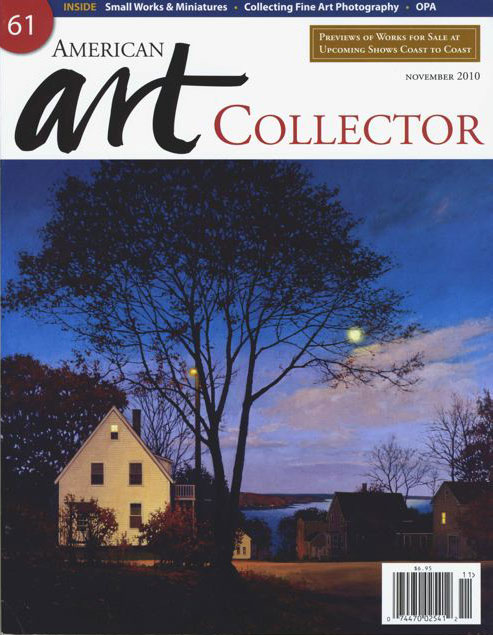
- John O'Hern, American Art Collector, November 2010
"Linden Frederick does not populate his paintings with people. But as surely as the sun sets each night, his paintings are portraits... Frederick's paintings convey mood and tell stories. Some are short stories and some are novels, but all are pictures of well-trodden lives.
To the casual observer, Frederick's work presents itself as Realism, which to some degree is an accurate description. But his paintings go much deeper than realistic portrayals of everyday scenes. Frederick is keenly interested in the stories behind the scenes that he paints. His paintings are rarely as they appear on the surface, and usually are full of subtext.
It's probably not surprising that writers and filmmakers are fans of Frederick and his paintings. His work is lyrical, brimming with narration and mystery... [it] is multi-faceted. It is rich in detail, and also swimming in what is not there and what we must fill in with our imaginations."
- Bob Keyes, Maine Sunday Telegram, May 2009
"Linden Frederick is a precision realist painter, yet his exactitude strikes me as truth, a personal truth, a 21st century romanticism that elevates mundane scenes of Maine into the realm of poetic illusion. The places Frederick chooses to paint are not in and of themselves naturally beautiful, but in often painting them at twilight or night he imparts a sense of Hopper-esque loneliness and loveliness that is more a matter of his own poetic sensibility than of anything inherent in what he is looking at. He also tends to paint human landscapes devoid of human figures such that the human presence is a function both of the lights radiating from within buildings and of the viewer ("You Are Here") looking upon the scene."
- Edgar Allen Beem, Yankee Magazine, May 2008 review of Linden Frederick - YOU ARE HERE: Studies and Paintings, CMCA, Rockport, Maine, April - July, 2009
"Setting a situational stage, Frederick gives us enough information to complete the scene according to our own experience, associations, and feelings. It has been frequently noted that many of Frederick's paintings are dawn or dusk scenes. The concomitant stillness and calm seem suspended in time, and, given Frederick's deep connection to music, it may be valid to think of his works as having an association with both music and time. Immersed in one of his paintings, we sense that something just happened and still lingers, like the sound of music we still hear long after the last note has been struck."
- Britta Konau, Excerpt from an essay for Linden Frederick - YOU ARE HERE: Studies and Paintings, April, 2009
"[Linden Frederick's] work's effect on the viewer is burnished by his oil technique, but the technique serves as underpinning to, rather than as the point of, his art: Everything painterly in his paintings is subsumed in fealty to the power of reality - a reality that is uniquely his, but also uniquely American.
Paintings like Frederick's not only elevate the ordinary, they affix our gaze on the intense beauty at the heart of everyday existence, and evoke, at the same time, a kind of retrospective wonder for what we've seen a thousand times and overlooked."
- Michael Antman, PopMatters
click here for the entire posting
"[Linden Frederick's paintings] are the most unusual applications of realism to common ordinary everyday subjects that I can recall, and definitely the first time I've seen such an approach so consistently pursued... What I'm talking about is the fact that most of his paintings are set in twilight. Any subject can be represented this way... but one major thing that draws me in (besides his highly accomplished, at times masterful technique) is his choice of subjects. It looks to me like Mr. Frederick and I grew up and have traveled through life in some very similar surroundings. I mean, these images could all have been lifted right out of my memory banks. He's tapped into my demographic, I guess you could say."
- Albert Decker- Resonant Enigma
click here for the entire posting
mhd_cover08 "... Linden Frederick is one of the foremost painters of America's byways, highways, and backyards. He can make the humblest objects or places... resonate with mystery... and is a poet of the overlooked. The painter also has a passion for dusk. His ability to capture the most subtle gradations of twilight using oil paints is remarkable."
- Carl Little, Maine Home + Design, April 2008
click to download the article [pdf ~1.0mb]
"On a recent drive through the countryside, I kept recalling a group of paintings by the artist Linden Frederick at Forum (from his show there called "Memoir"). These are the most eloquent distillations I have ever seen of a certain rural experience - that of an outsider wondering what it might feel like to live "here". Frederick's viewpoint is liminal in all respects. His modest sublime has roots in Edward Hopper and, in the quality of light especially, the Hudson River School."
- Faye Hirsch, Review (excerpts)
Art in America, April 2005.
"In these paintings, inspired by memory, Frederick links the imagination and the past so as to celebrate the world's obstinate there-ness and simultaneously give evidence of our vital relation to it. He shows us that seeing more is better than seeing less, and assures us that art is good for this purpose.
There's always a sweet moment...when I, and probably anyone, first sees a Linden Frederick painting, incandescent and full of dense experience and vivid longing - a moment when we say, "Yes! There's life, exactly. He got it. It's amazing." And the truth is, he did get it, and it is amazing, and life's certainly that way.
This is a painter in charge of his choices, working at the sheer edge of what he knows, at the breathtaking and exacting point at which his great abilities, sympathies and large intentions perfectly elide. This is heady, humane and irresistible work simply to stand and see. And when I stand ad see it I always feel the same: how lucky am I to have this in life."
- Richard Ford, Excerpts from an essay for Memoir, 2004
"Linden Frederick is one of those intrepid souls willing to report the true condition of how we live today. He bravely goes where few of his cohorts dare to even steal a glance. The mood of desolation he captures is palpable and in some ways even gorgeous. Often a light is burning somewhere in or around the subject to remind us that inside dwells the remnant of a human spirit."
- James Howard Kunstler, Overlooked Landscapes
Orion, July/August, 2004.
"The works in this show, American Nights, are exquisite testaments to the enduring optimism of small-town America. In painting after painting, Frederick distills the essence of the physical and emotional atmosphere, creating poignant portraits of time and place.
Much has been written of the quality of light in Linden Frederick's paintings. It is a tangible presence; it establishes the mood, illuminates important details, and evokes a human presence. In a recent review, The New Yorker wrote of Frederick's work, "There are painterly precedents for scenes of such vital loneliness, but the literary echoes are stronger - Steinbeck, McCullers, or Richard Ford." .... we also think of the songs of Woody Guthrie.... the industrial landscapes of Charles Sheeler and other earlier painters who both celebrated and lamented the development of America.
Despite his love of beauty and the poetic, Frederick is not a romanticist. He is a realist who revels in what he sees. That he sees with more clarity than most of us is to our gain."
- Suzette Lane McAvoy, Excerpt from an essay for American Nights, 2002
"Dusk - that time of day when dark and light blend together together into a hybrid of shades, shapes and emotions - can be unsettling. It can also be a time of relaxation and reflection. Both emotions are apt when Linden Frederick creates dusk with his paints. The ultimate effect of his nightscapes of quintessential American towns and structures is to capture not so much a place as a feeling.
What those feelings turn out to be is up to each viewer who takes in Frederick's work... You may find yourself longing for a time past when things were simpler (or so it seemed), or for that corner barbershop where Ed would happily chat away with you while he clipped, or for a place to stop for the night on your way from somewhere to nowhere, or nowhere to somewhere. On a 40-in-square canvas Frederick tells you the history of a place and the people in that place. Actually, you'll have to write the history, but he'll give you enough information to fill in the blanks.
Frederick's canon includes paintings of isolated barns, nearly deserted streets, dying minimalls and small-town barbershops, all devoid of human figures but full of life. While the places in his paintings do exist, he alters them slightly by playing with the light to give them a magical, or mysterious, feeling. First he does considerable foundation building, repeatedly visiting a site and taking photographs at a different times of the day. He doesn't put people into the works because he figures the viewer will do that.
'When there is a figure in a painting, the painting becomes about the person. That's unavoidable,' he explained. 'If you don't put people in it, if you just suggest them...the viewer becomes curious about looking further.'
If you're the type who likes to look into a painting, or a room, or down a street and see what's what right away, Frederick's art may not be for you. But if you like to stroll the streets at night and look up at a well-lit window and wonder what's going on in there, his American Nights exhibit will be right up your alley."
- Santa Fe New Mexican (excerpts), 10/11/2002 by Robert Nott.
"Linden Frederick seems most at home on the road. The roadside America he depicts - gas stations, railroad yards, drive-ins, motels, isolated houses and barns - appears relentlessly ordinary at first glance, but this extraordinary painter finds its potential poetry. His subjects are Hopperesque, yet his vision less bleak. Light is the transfiguring agent...and Frederick communicates a reticent tenderness for man-made structures and by extension, for their largely unseen inhabitants.
Although he was trained at the Ontario College of Art and the Academia de Belle Arte in Florence, no one would mistake Frederick for anything but an American. His point of view suggests the independence, freedom and often loneliness that comes with American individuality. Unlike the sometimes voyeuristic Hopper, Frederick keeps his distance, rarely getting close enough to look inside the buildings he depicts. At the same time he cannot be characterized principally as a landscapist, like Goerge Inness. Frederick's territory - physically and psychologically - lies between urban and rural; his chosen genre is poised between landscape and cityscape. The sense of a lingering human presence complicates his landscapes, which fully acknowledge the power and beauty of nature. The simple forms of vernacular architecture - and the occasional presence of proprietary signs on boxcars and store windows - shoulds be overwhelmed by the sky, yet somehow they co-exist and thrive, thanks to this artist's painterly grace and special way of reconfiguring the relationship visually."
- American Arts Quarterly, Fall 2002
"These canvases train the eye for the moody tricks of color at dusk. Big skies dwarf unpeopled landscapes that nevertheless hum with fond detail: the lights of a town almost hidden on the horizon, the lime reflection of a laundromat in a parking-lot puddle, the gradations of shadow on a rutted gravel road. There are painterly precendents for scenes of such vital loneliness, but the literary echoes are stronger - Steinbeck, McCullers, or Richard Ford."
- The New Yorker, November 29, 1999
"Bathed in a gloomy combination of natural and artificial light, Linden Frederick's oil paintings reconstruct a world easily recognized but often overlooked. When Frederick talks about the American landscape, he doesn't mention rolling hills intersected by rushing streams or marked with maple trees. The scenes that interest this Maine-based painter are those that embody today's rural America - a country defined by its mobile society and the everyday places people live and work."
-American Artist, March 1999
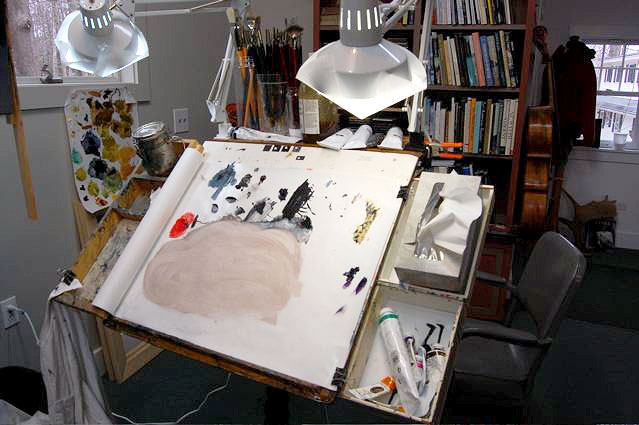
"It is the ordinary that catches Linden Frederick's eye, and in his studio he turns the commonplace into the archetypal. Light, especially the transition between day and night, is what this artist explores in his Belfast studio. 'I love the mood at dusk. It's a magic hour when inside and outside lights are very similar. It's the time of day when people are coming home and the lights come on, and I try to translate that mood into a visual image.'
Does he ever paint people? 'Never,' he replies, but insists his work is all about people indirectly."
- Down East, August 1996
"Frederick's subject matter tends to go against the picturesque New England landscape tradition. He is drawn to the nondescript places one passes all the time without taking them in.
Frederick's palette can be moody. Eschewing the easy theatrics of latter-day Romantics and the sere realism of Wyeth, this artist wields a live brush. Frederick renders the landscape with great skill and a good deal of daring."
- Art in America, May 1996